

Glean Meaning in Bible
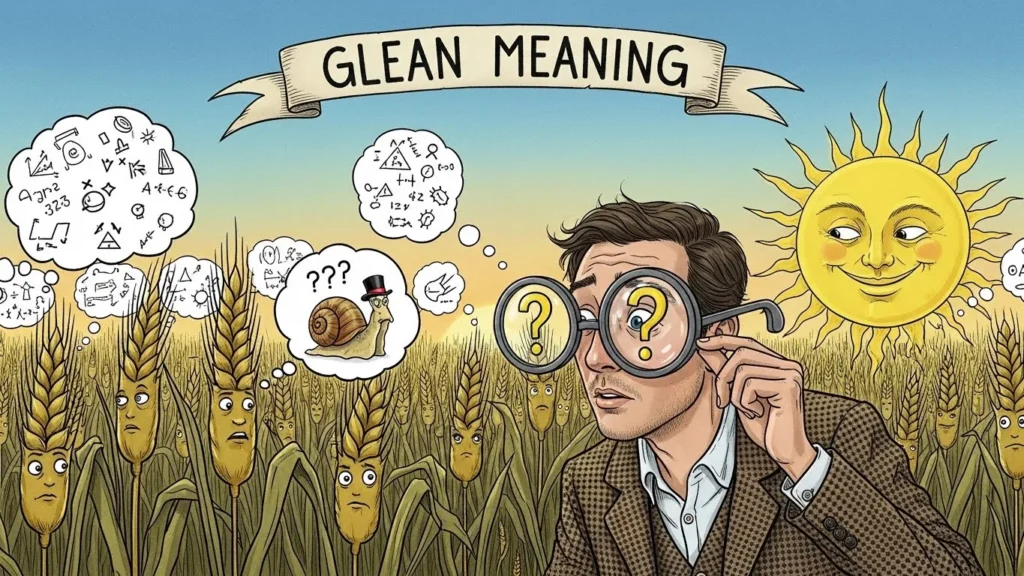
In the Bible, “glean” refers to the practice of collecting leftover crops from fields after harvest. This was allowed for the poor, widows, and strangers as a form of charity.
Example:
- The story of Ruth shows her gleaning in the fields to gather food.
Glean Meaning in English
In English, “glean” has two main meanings:
- To gather leftover crops from a field
- To collect information slowly or carefully
Example:
- “She gleaned useful facts from the report.”
Glean Synonym
Common synonyms of “glean” include:
- Gather
- Collect
- Extract
- Obtain
- Pick up
These words reflect the idea of collecting something gradually.
Glean Meaning in Chinese
In Chinese, “glean” can be translated as:
- 收集 (shōují) – to collect
- 拾穗 (shí suì) – to glean crops
The second term specifically relates to farming.
Glean Meaning Farming
In farming, “gleaning” is the act of collecting leftover grains or crops after the main harvest. It is often done by hand and traditionally supports those in need.
Glean Meaning in Arabic
In Arabic, “glean” can be translated as:
- “يجمع” – to gather
- “يلتقط” – to pick up or collect
It reflects both physical and informational collection.
Glean in a Sentence
Examples:
- “Farmers allowed villagers to glean after harvest.”
- “He gleaned valuable insights from the meeting.”
- “She gleaned information from different sources.”
Gleen Meaning
“Gleen” is usually a misspelling of “glean.”
The correct word is “glean.”

What Does “Glean” Mean?
Glean meaning is a verb that primarily means:
To collect or gather bit by bit.
To extract information or understanding slowly and carefully.
In simple words: glean = gather small pieces to get the full picture.
Example:
“She gleaned useful tips from the lecture to improve her project.”
Origin of the Word “Glean”
From Old French: glener, meaning “to gather grain left by reapers.”
Historical meaning: Originally agricultural, referring to collecting leftover crops after a harvest.
Over time, it evolved to mean gathering information, ideas, or insights.
Glean Meaning in Simple Words
Collecting small amounts of information or resources.
Picking up details or insights gradually.
Learning something carefully by observation or study.
Example:
“By reading different articles, she gleaned an understanding of the topic.”
Different Contexts of Glean
Agricultural: Collecting leftover crops in a field.
“Workers gleaned the wheat that was left behind after harvest.”
Information gathering: Extracting knowledge or insights slowly.
“Reporters gleaned details from multiple sources to write the article.”
Personal growth: Learning from experiences or observations.
“He gleaned wisdom from years of traveling.”
Literary use: Often used in books or essays to describe careful discovery.
“The historian gleaned facts from old manuscripts.”
Real-Life Examples of Glean
“Students glean meaning information from textbooks, notes, and lectures to prepare for exams.”
“By talking to locals, the researcher gleaned cultural insights.”
“She gleaned inspiration from her favorite author’s works.”
“The detective gleaned clues from small details at the crime scene.”
“From casual conversations, he gleaned what people really thought about the project.”
Common Misunderstandings About Glean
Not just reading quickly: Glean implies careful collection, not hasty reading.
Not only for facts: Can be insights, ideas, or even emotions.
Not the same as “grab” or “take”: Glean is gradual and thoughtful.
Glean in Modern Usage (2026)
In journalism: “Reporters gleaned information from interviews and documents.”
In education: “Students glean knowledge by reviewing lectures and resources.”
In social media: “You can glean trends by observing what’s popular online.”
In daily life: “I gleaned some good advice from my mentor.”
Related Words
Extract: Take out specific information
Gather: Collect items or information
Harvest: Originally agricultural, similar to glean
Scrutinize: Examine carefully to glean details