
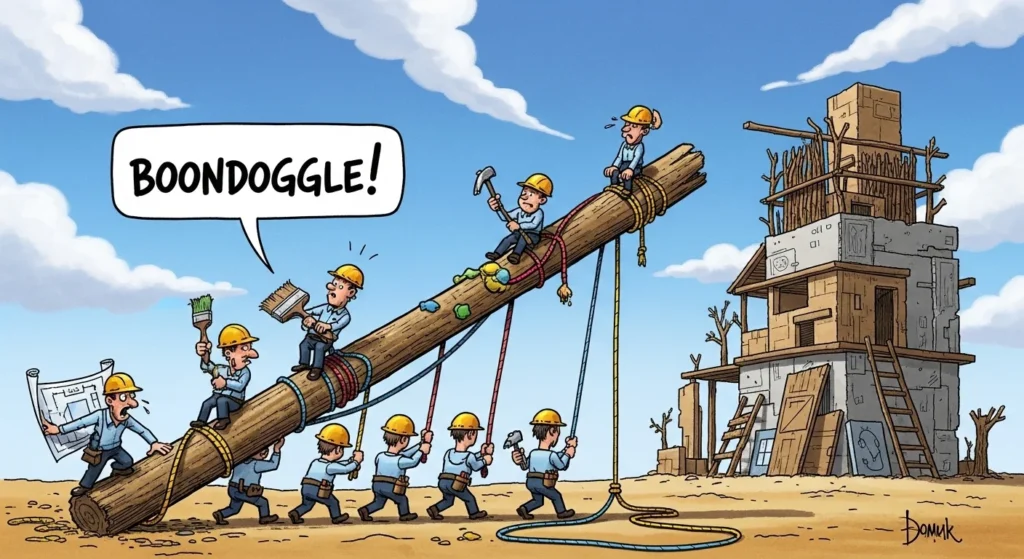
You may have heard someone complain about a project and call it a “boondoggle” and wondered what that word actually means. Many people search for boondoggle meaning because it appears often in news, office conversations, and political discussions. In 2026, the word is still widely used to describe work that looks impressive on the surface but secretly wastes time or money. Understanding the real meaning of boondoggle helps you recognize inefficient projects and speak more clearly in professional and public discussions.

What Does “Boondoggle” Mean?
The basic and most accurate boondoggle meaning is:
A boondoggle is a project, task, or activity that wastes money, time, or effort, usually because it is badly planned or unnecessary.
In simple words:
a boondoggle looks important
but produces very little real value
It is often used in negative or critical situations.
Simple Definition of Boondoggle in Easy English
You can remember it like this:
Boondoggle = expensive or time-consuming work that gives almost no useful result
Examples include:
unnecessary projects
over-funded programs
complicated systems that solve simple problems
This is the core idea behind the modern boondoggle meaning.
Where Did the Word “Boondoggle” Come From?
The word boondoggle originally appeared in American English in the 1930s.
It became popular during the Great Depression, when the government created large public work programs. Some critics believed that certain projects:
were created mainly to keep people busy
did not produce real long-term value
These projects were described as boondoggles.
So historically, the boondoggle meaning has always been connected to:
public money
questionable value
political criticism
Boondoggle Meaning in the Workplace
In modern offices and companies, people use boondoggle to describe internal projects.
For example:
a complicated system that nobody uses
a long research project with no clear outcome
endless meetings that do not improve results
In workplace language, boondoggle meaning becomes:
a wasteful or pointless work project that exists more for show than for real impact.
Boondoggle Meaning in Government and Politics
This is one of the most common contexts for the word.
In political and public discussions, boondoggle usually refers to:
a government project that costs a lot of money but gives very little benefit to the public.
Examples may include:
unused buildings
delayed infrastructure projects
technology systems that never work properly
Journalists and citizens often use the word boondoggle to criticize how public funds are spent.
Boondoggle Meaning in News and Media
You will often see headlines such as:
“Opposition calls the project a boondoggle”
“Taxpayers angry over costly boondoggle”
In media language, boondoggle meaning signals:
public frustration
financial waste
poor planning
It is a strong but common word used to express dissatisfaction without using offensive language.
Boondoggle Meaning in Everyday Conversation
In everyday speech, people may use boondoggle in a lighter way.
For example:
“That training program was a complete boondoggle.”
“The whole event turned into a boondoggle.”
Here, boondoggle meaning is less political and more casual. It simply means:
a badly organized activity that wasted time and energy.
Real-Life Examples of “Boondoggle” in Sentences
Example 1
“The new software system turned out to be a boondoggle.”
Explanation: The system was expensive and complicated but did not help the company.
Example 2
“Critics say the construction project is a public boondoggle.”
Explanation: The project uses public money but brings little real benefit.
Example 3
“Our team spent three months on a boondoggle that nobody approved.”
Explanation: The project had no clear purpose or value.
These examples show how boondoggle meaning changes slightly by context, but always keeps the idea of waste.
Boondoggle as a Noun and as a Verb
The word can be used in two main ways.
Boondoggle as a noun
“That project is a boondoggle.”
“The program became a boondoggle.”
Here, boondoggle refers to the project itself.
Boondoggle as a verb
“They boondoggled millions of dollars.”
“The company boondoggled its budget on useless tools.”
As a verb, boondoggle means:
to waste money or resources through poorly planned work.

What Makes a Project a Boondoggle?
Not every failed project is a boondoggle.
A project is usually called a boondoggle when:
it is very expensive
it lasts for a long time
it produces little real value
people suspect poor management or poor decisions
In short, boondoggle meaning includes both waste and bad planning.
Boondoggle Meaning vs Normal Project Failure
It is important to understand the difference.
A normal failed project:
may have been well planned
may fail due to market changes or unexpected problems
A boondoggle:
often looks wasteful from the beginning
is poorly justified
continues even when it clearly does not work
This difference helps you use the word boondoggle correctly.
Boondoggle Meaning in Business and Corporate Culture
In business, boondoggle often refers to:
large consulting programs
complex transformation projects
unnecessary digital tools
Managers may quietly describe such projects as:
budget boondoggles
leadership boondoggles
In corporate culture, boondoggle meaning reflects frustration with decision-making and leadership.
Boondoggle Meaning in Non-Profit and Public Organizations
Even in non-profit organizations, people use boondoggle to criticize:
fundraising campaigns that cost too much
programs that do not reach real beneficiaries
promotional activities with little impact
So the word is not limited to governments or corporations.
Boondoggle Meaning in Project Management Language
In project management discussions, a boondoggle is often associated with:
scope creep
unclear objectives
weak leadership
unrealistic deadlines
poor communication
From a professional view, boondoggle meaning can be summarized as:
a project that lacks clear value and proper governance.
Why People Use the Word “Boondoggle”
People choose this word because:
it sounds informal but serious
it clearly expresses waste
it avoids technical language
it communicates frustration quickly
That is why boondoggle remains popular in 2026, especially in public debate.
Boondoggle Meaning in Social and Online Discussions
On social media and forums, people often write:
“Another government boondoggle.”
“This startup idea feels like a boondoggle.”
Online, boondoggle meaning is usually emotional and opinion-based. It shows:
anger
disappointment
lack of trust in leadership
Boondoggle vs Similar Words
Understanding similar words helps clarify boondoggle meaning.
Boondoggle vs Waste
Waste is general.
Boondoggle specifically refers to wasteful projects or programs.
Boondoggle vs Scam
Scam involves intentional deception.
Boondoggle does not always mean fraud. It usually means bad planning or poor judgment.
Boondoggle vs White elephant
White elephant refers to something expensive to maintain and not useful.
Boondoggle focuses more on the project process and spending itself.
Common Expressions with Boondoggle
You may often see:
public boondoggle
government boondoggle
budget boondoggle
costly boondoggle
massive boondoggle
All of these follow the same core boondoggle meaning.
When Is It Appropriate to Use the Word Boondoggle?
Use boondoggle when:
you want to criticize a project
you believe the cost is unjustified
you think the value is very low
It is commonly used in:
opinion articles
political discussions
professional debates
It is less suitable in very formal or neutral reports.
How to Use “Boondoggle” Correctly in Your Own Writing
Here are simple tips:
Use it for projects, not people.
Make sure the context clearly shows waste or poor value.
Avoid using it when you have no evidence or explanation.
Good example:
“Many experts describe the program as a boondoggle due to its high cost and low impact.”
Boondoggle Meaning in International English
Although the word started in American English, it is now understood in:
British media
international business writing
global political reporting
In 2026, boondoggle meaning is recognized worldwide as a symbol of inefficient spending.
Why Boondoggle Is Still Relevant in 2026
With growing investment in:
digital transformation
artificial intelligence
public infrastructure
climate projects
people are more careful about how money is used. As budgets become larger and projects more complex, the risk of boondoggles increases.
This is why the word continues to appear frequently in modern discussions.

Rlated Words and Expressions
If you are learning vocabulary connected to boondoggle meaning, you may also encounter:
mismanagement
cost overrun
budget waste
inefficiency
failed initiative
These words often appear in the same articles and reports.
Frequently Asked Questions
What is the simple boondoggle meaning?
Boondoggle means a project that wastes time, money, or effort and produces little real value.
Is boondoggle always related to government projects?
No. It can describe business, corporate, non-profit, or even personal projects.
Does boondoggle mean fraud?
Not necessarily. It usually means poor planning or weak decision-making, not criminal behavior.
Can boondoggle be used as a verb?
Yes. It can mean wasting resources through badly managed projects.
Is boondoggle a negative word?
Yes. It is clearly critical and usually expresses dissatisfaction.
Conclusion
Understanding the real boondoggle meaning helps you recognize and describe projects that consume large amounts of money, time, or effort without delivering real value. Whether you see the word in political news, corporate meetings, or everyday conversation, a boondoggle usually points to poor planning and disappointing results rather than simple failure.