
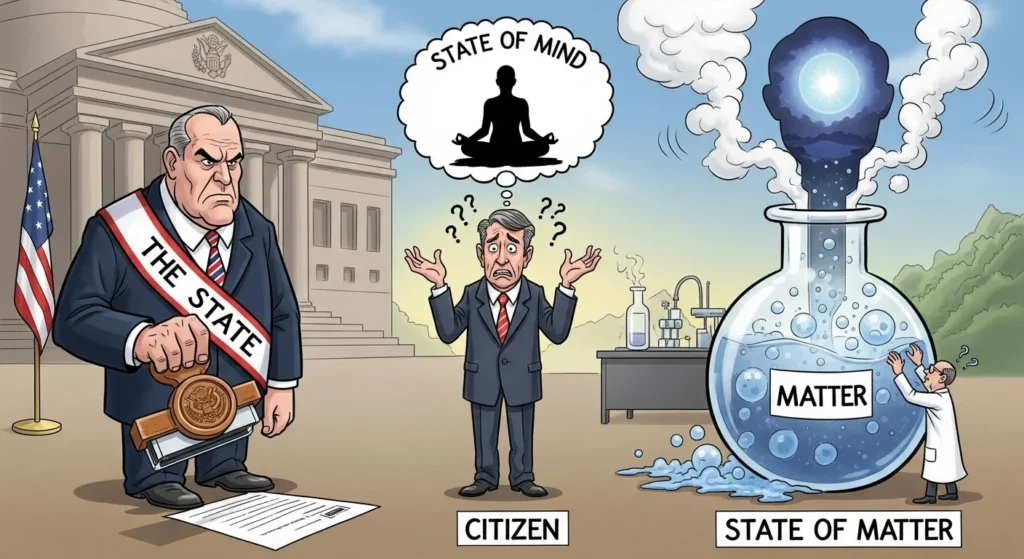
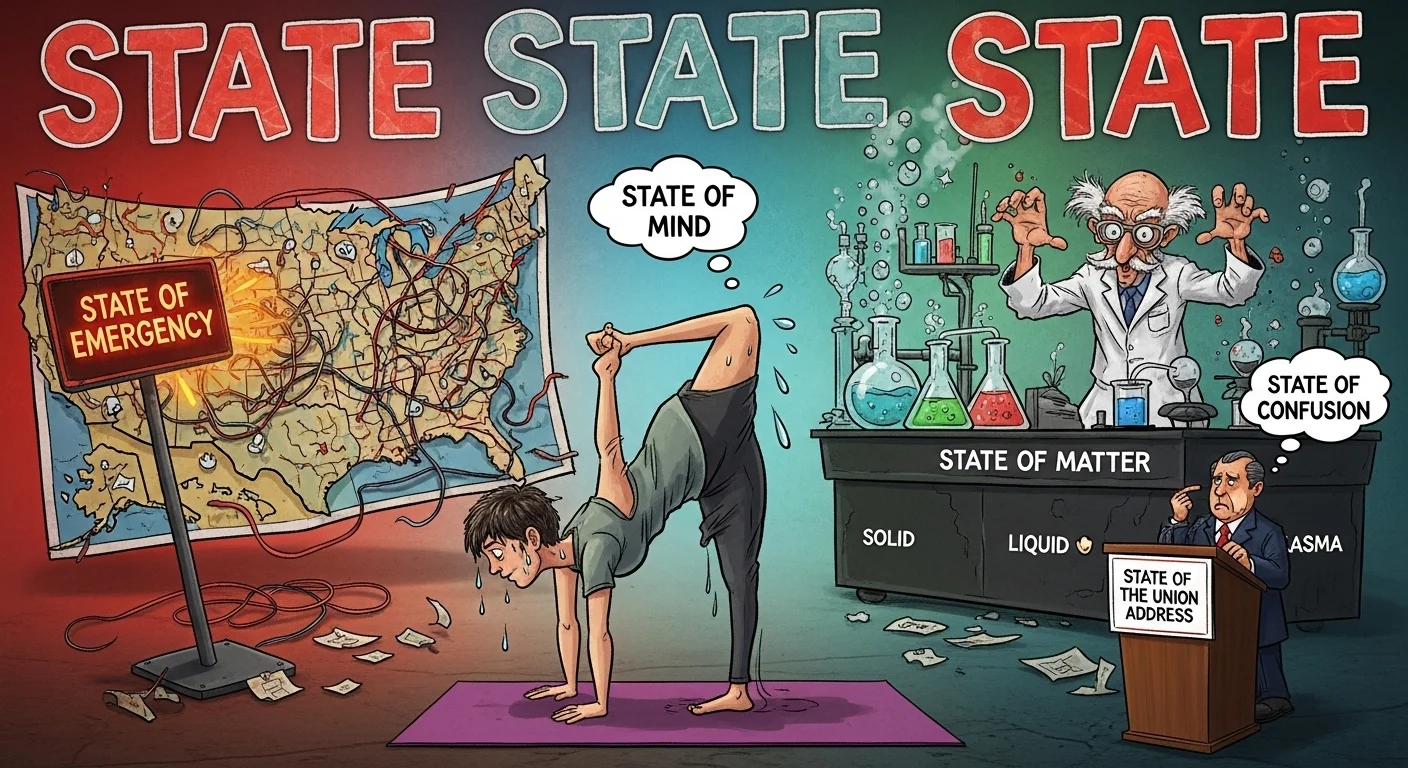
What Does “State” Mean?
The basic and correct state is:
State means the condition, situation, or form of something at a particular time — or a political area with its own government.
So, “state” can describe:
how something is
or a type of political region
Context decides which meaning is correct.
State in Simple English
In very simple words:
state = condition or situation
state = a political region or country
Both meanings are very common in modern English.
State as a Condition or Situation
One of the most common uses of state is to describe how something is.
For example:
“The house is in a bad state.”
“She was in a state of shock.”
Here, state meaning refers to the condition or situation.
State in Everyday Conversation
In daily English, people often use state like this:
“My phone is in perfect state.”
“The project is in a difficult state.”
“He arrived in a tired state.”
In these sentences, state is simply about condition.
State in Government and Politics
Another very important state refers to a political area.
In politics, a state is:
a country or a major political region with its own government.
For example:
“The state passed a new law.”
“Pakistan is a sovereign state.”
In the United States, a state means:
one of the main regions such as California, Texas, or New York.
State in International Context
In global news and international relations, state usually means:
a nation or country
For example:
“The two states signed an agreement.”
Here, state is the same as a nation with a government.
State in Mental and Emotional Context
State is also used to describe a person’s mental or emotional condition.
For example:
“He was in a nervous state.”
“She is in a calm state of mind.”
Here, state meaning refers to emotional or psychological condition.
State Meaning in Formal and Written English
In formal writing, state is often used as a noun to describe a situation.
For example:
“The current state of the economy is improving.”
“The company reviewed the state of its operations.”
This usage is very common in reports and academic writing.
State Meaning as a Verb
State can also be a verb.
As a verb, state means:
to say or express something clearly in words.
For example:
“Please state your name.”
“The report states that sales increased.”
Here, state meaning changes completely and refers to speaking or writing information.
Difference Between “State” (Noun) and “State” (Verb)
It is important to separate the two forms.
Noun: state = condition or political region
Verb: state = to say or declare
Understanding this difference helps you avoid confusion in reading.
Real-Life Examples of State Meaning
Example 1
“The building is in a poor state.”
Explanation: State means condition.
Example 2
“The state introduced a new education policy.”
Explanation: State means government or political authority.
Example 3
“She clearly stated her opinion.”
Explanation: State is a verb meaning to say.
These examples show the most common uses of state meaning.
State Meaning in Education and Exams
In exam questions, you often see:
“State two reasons…”
“State the main causes…”
Here, state meaning is:
to write or say briefly and clearly.
This is a very common academic instruction.
State Meaning in Science and Physics
In science, especially physics and chemistry, state means:
the physical form of matter.
For example:
solid state
liquid state
gaseous state
Here, state meaning refers to physical condition.
State Meaning in Technology and Systems
In computing and systems, state can mean:
the current condition or status of a system.
For example:
“The app saves the user’s state.”
“The system returned to its previous state.”
This is common in technical and software language.
State Meaning in Law and Administration
In legal and administrative language, state can refer to:
the government
public authorities
For example:
“The case was brought by the state.”
Here, state meaning refers to official public power.
How to Know Which State Meaning Is Used
To understand state meaning correctly, ask:
Is it talking about condition or situation?
Is it talking about a government or country?
Is it asking someone to say something?
The sentence around the word will tell you.
State Meaning Compared to Similar Words
State is often similar to:
condition
situation
status
country
government
But state is more general and flexible than most of these words.
Common Phrases Using “State”
You will often hear:
state of mind
state of affairs
state of emergency
in a bad state
state clearly
These expressions use different meanings of the word.
Related Words and Concepts
If you are learning state meaning, you may also want to understand:
status
nation
government
condition
declare
These words often appear near “state” in writing.