

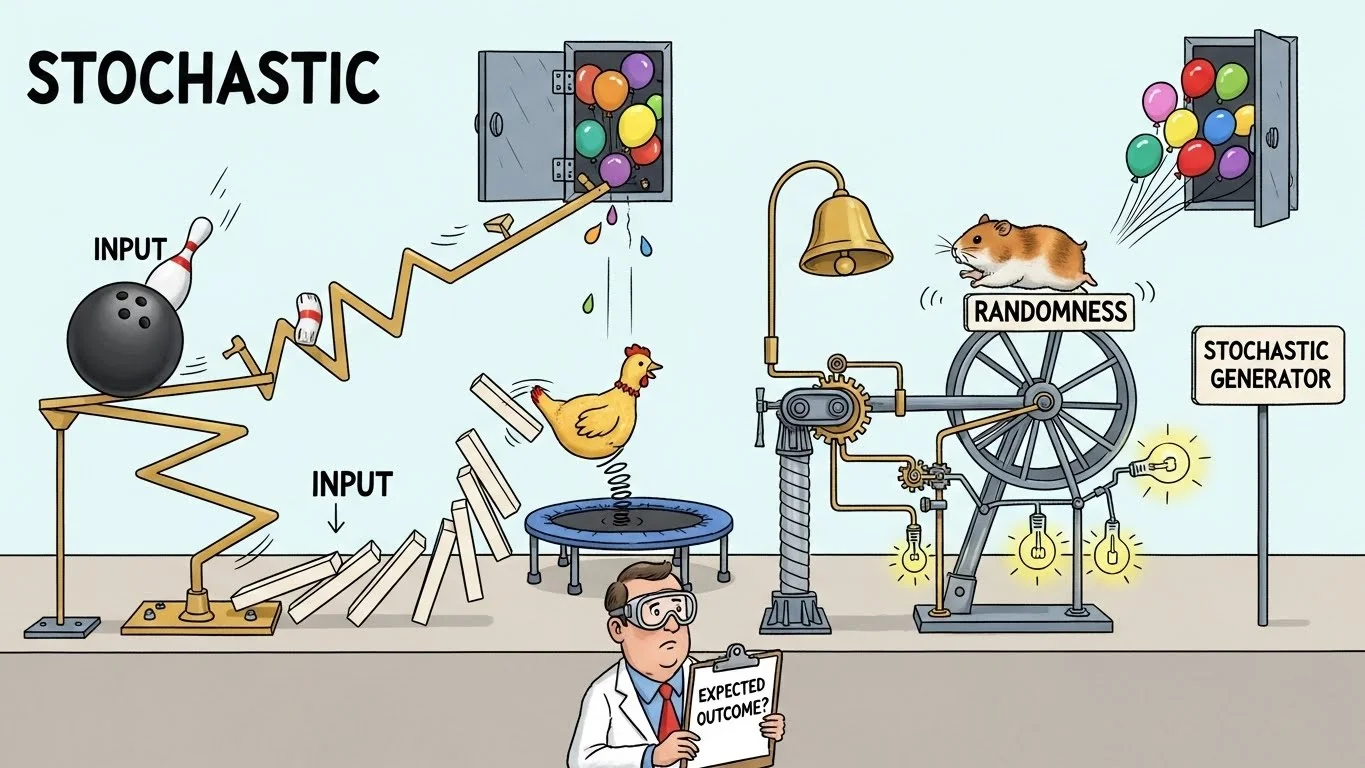
What Does “Stochastic” Mean?
Stochastic means involving randomness, probability, or chance.
In simple terms:
If something is stochastic, it cannot be predicted with complete certainty because random factors are involved.
Instead of producing the same result every time, a stochastic process can produce different outcomes, even if it starts the same way.
Stochastic Meaning in Simple Words
In everyday language, stochastic means:
Random
Unpredictable
Based on probability
Influenced by chance
If something depends on luck, randomness, or probability rather than fixed rules, it is stochastic.
Origin and History of the Word “Stochastic”
The word stochastic comes from the Greek word stokhastikos, meaning:
“Able to guess”
“Skillful in aiming”
“Conjectural”
Over time, the meaning shifted toward uncertainty and probability, especially in mathematics and science.
Stochastic vs Deterministic: Key Difference
Understanding stochastic is easier when compared to its opposite.
Deterministic
Same input → same output
Fully predictable
No randomness
Stochastic
Same input → different possible outputs
Partly unpredictable
Randomness involved
Example:
A calculator is deterministic.
Rolling a dice is stochastic.
Stochastic Meaning in Mathematics
In mathematics, stochastic refers to:
Processes involving random variables
Outcomes described by probability distributions
Examples include:
Random walks
Probability theory
Statistical models
Math uses stochastic models to predict likelihoods, not exact outcomes.
Stochastic Meaning in Statistics
In statistics, stochastic processes:
Model random data over time
Help analyze uncertainty
Estimate trends rather than exact values
For example:
Stock prices
Weather data
Population growth
All include randomness and are studied using stochastic methods.
Stochastic Meaning in Machine Learning and AI
In artificial intelligence and machine learning, stochastic methods are extremely common.
Examples include:
Stochastic gradient descent
Random sampling
Probabilistic models
Here, stochastic techniques:
Improve learning efficiency
Prevent overfitting
Help systems adapt to uncertainty
This is why stochastic methods are critical in modern AI systems.

Stochastic Meaning in Finance and Economics
In finance, stochastic models are used to:
Predict stock market behavior
Estimate risk
Model price fluctuations
Markets are stochastic because:
Human behavior is unpredictable
External events affect outcomes
Prices fluctuate randomly
No financial model is perfectly deterministic.
Stochastic Meaning in Science and Nature
Many natural processes are stochastic, such as:
Genetic mutations
Radioactive decay
Weather patterns
Even with advanced tools, scientists use probability to explain outcomes because randomness plays a role.
Real-Life Examples of Stochastic Processes
Here are easy examples most people relate to:
Tossing a coin
Rolling dice
Daily stock price changes
Traffic flow
Customer arrival times in a store
Each outcome is uncertain, but patterns emerge over time.
Why Stochastic Models Are Important
Stochastic models help us:
Deal with uncertainty
Make informed predictions
Estimate risks
Understand complex systems
They don’t promise certainty, but they improve decision-making.
Common Mistakes About the Word “Stochastic”
Many people misunderstand stochastic as:
Completely chaotic (it’s not)
Meaningless randomness (it’s structured)
The same as “random” (it’s more precise)
Stochastic processes follow probability rules, not total disorder.
Stochastic vs Random: Are They the Same?
They are related but not identical.
Random is informal and general.
Stochastic is technical and structured.
Stochastic implies randomness that can be measured, modeled, and analyzed.
When to Use the Word “Stochastic” Correctly
Use “stochastic” when:
Talking about probability-based systems
Describing uncertain outcomes
Discussing models in science, math, or data analysis
Avoid using it as a casual synonym for “messy” or “confusing.”

Related Terms and Concepts
Probability
Random variable
Deterministic
Statistical model
Random process
These terms often appear alongside stochastic in academic and professional contexts.